

Sustainability · 2025
In this section51 topics
- Sustainability Policy2 items
- Sustainability Goals & UN SDGs3 items
- Policy Review3 items
- Business Value Chain1 item
- Stakeholder Analysis2 items
- Environmental Policy & Guidelines5 items
- Environmental Policy Review3 items
- Energy — Plan & Guidelines3 items
- Energy — Electricity Consumption1 item
- Energy — Fuel Consumption1 item
- Energy — Targets2 items
- Energy — Performance & Outcomes2 items
- Water — Plan & Guidelines3 items
- Water — Withdrawal, Discharge & Consumption1 item
- Water — Targets3 items
- Water — Performance & Outcomes2 items
- Waste Management — Overview1 item
- Waste — Plan & Guidelines2 items
- Waste — Generation, Disposal & Recycling1 item
- Waste — Targets1 item
- Waste — Performance & Outcomes2 items
- GHG — Plan & Guidelines3 items
- GHG — Emissions1 item
- GHG — Emissions Verification2 items
- GHG — Principles & Standards1 item
- GHG — Targets1 item
- GHG Targets — Other Targets1 item
- GHG — Performance & Outcomes2 items
- Environmental Legal Incidents1 item
- Other Environmental Management2 items
- Social Policy & Guidelines4 items
- Social Policy Review1 item
- Social — Principles & Standards Practised1 item
- Human Rights Due Diligence2 items
- Employees — Plan & Guidelines3 items
- Employees — Workforce1 item
- Employees — Remuneration & Provident Fund1 item
- Employees — Training & Development1 item
- Employees — Occupational Health & Safety1 item
- Employees — Labour Relations1 item
- Employees — Employee Representation2 items
- Employees — Targets2 items
- Employees — Performance & Outcomes2 items
- Customers — Plan & Guidelines4 items
- Customers — Satisfaction Results1 item
- Customers — Targets2 items
- Customers — Performance & Outcomes2 items
- Community & Social — Plan & Guidelines4 items
- Community & Social — Targets1 item
- Community & Social — Performance & Outcomes2 items
- Law Violation Incidents1 item
Sustainability Policy
Has a Sustainability Policy
Yes
Policy Description
The Company is determined to develop and operate the business to create sustainable growth for the organization according to the vision, mission and values of the organization, and strives to meet stakeholders' expectations while upholding the principles of good governance and corporate ethics. In today’s dynamic landscape, various challenges and risks may directly or indirectly impact the Company’s short- and long-term objectives. Therefore, the Company places great importance on fostering engagement and strengthening relationships with stakeholders to assess potential business impacts, forming a foundation for policy and strategy development.
The sustainability framework is established with consideration and approval from the Company’s management. Strategies and operational plans are developed within this framework and reviewed annually. Serving as a key guideline for driving tangible sustainable development, the framework encompasses business unit activities. These plans are submitted by management to the Board of Directors for approval, with continuous monitoring of progress against set objectives.
Sustainability Goals & UN SDGs
Has Sustainability Goals
Yes
Goals Description
The Company has set sustainability management targets in the areas of economic and governance, environment, and society, aligned with global sustainability standards such as the United Nations Sustainable Development Goals (UNSDGs), Creating Shared Value (CSV), the United Nations Guiding Principles on Business and Human Rights (UNGP), sustainability assessments, and ISO standards such as ISO 14001 (Environmental Management) and ISO 45001 (Occupational Health and Safety). These targets developed with consideration of stakeholders' expectations align with the Company's vision and strategy. Business units are responsible for defining direction and operational steps to achieve objectives within the specified timeframe, with progress periodically reported to management and the Board of Directors.
The Company's sustainability management targets for the years 2025-2028 in each dimension are as follows:
Economic
- Sales Revenue Growth (%): Target growth from the previous year is 5-10%
- Customer Satisfaction: Target customer satisfaction level for products and services is 80%
Social
- Creating safe work environment and minimizing absence due to occupational accidents: Target zero absences due to occupational accidents
- Employee Satisfaction and Engagement with the Organization: Target high levels of employee satisfaction and engagement at a score of 3.68 or higher out of 5.00, equivalent to 74%
Environmental
- Reduction in electricity consumption per product unit: Target to reduce electricity consumption per product unit from the base year 2024 (4.19 kWh per battery) by 10%, 13%, 17%, and 20% for the years 2025-2028, respectively
- Reduction in LPG fuel consumption per product unit: Target to reduce LPG consumption per product unit from the base year 2024 (215.6 g per battery) by 17%, 19%, 21%, and 24% for the years 2025-2028, respectively
- Reduction in greenhouse gas emissions intensity: Target to reduce greenhouse gas emissions intensity from its primary sources - electricity and LPG consumption - from the 2024 baseline of 1.02 to no more than 0.89 by 2028
- Control of city water usage: Target to reduce city water withdrawal from 2024 baseline of 164,605 cubic meters to no more than 124,198 cubic meters by 2028
UN Sustainable Development Goals
| SDG Goal |
|---|
| Goal 1 No Poverty |
| Goal 1 No Poverty |
| Goal 2 Zero Hunger |
| Goal 2 Zero Hunger |
| Goal 3 Good Health and Well-being |
| Goal 3 Good Health and Well-being |
| Goal 4 Quality Education |
| Goal 4 Quality Education |
| Goal 5 Gender Equality |
| Goal 5 Gender Equality |
| Goal 6 Clean Water and Sanitation |
| Goal 6 Clean Water and Sanitation |
| Goal 7 Affordable and Clean Energy |
| Goal 7 Affordable and Clean Energy |
| Goal 8 Decent Work and Economic Growth |
| Goal 8 Decent Work and Economic Growth |
| Goal 9 Industry, Innovation and Infrastructure |
| Goal 9 Industry, Innovation and Infrastructure |
| Goal 10 Reduce Inequalities |
| Goal 10 Reduce Inequalities |
| Goal 11 Sustainable Cities and Communities |
| Goal 11 Sustainable Cities and Communities |
| Goal 12 Responsible Consumption and Production |
| Goal 12 Responsible Consumption and Production |
| Goal 13 Climate Action |
| Goal 13 Climate Action |
| Goal 14 Life below Water |
| Goal 14 Life below Water |
| Goal 15 Life on Land |
| Goal 15 Life on Land |
| Goal 16 Peace, Justice and Strong Institutions |
| Goal 16 Peace, Justice and Strong Institutions |
Policy Review
Policy Reviewed This Year
Yes
Policy Changed This Year
Yes
Review Details
In 2025, the Company reviewed its corporate sustainability targets regarding the environment. This included setting specific greenhouse gas (GHG) emission reduction targets for primary sources, namely electricity and LPG consumption. These emissions are measured relative to the unit of the primary raw material, lead. Furthermore, the Company revised its external water consumption and employee satisfaction and engagement targets. These updates are integral components of the Company’s Mid-Term Strategic Plan for 2026 - 2028.
Business Value Chain
Value Chain Description
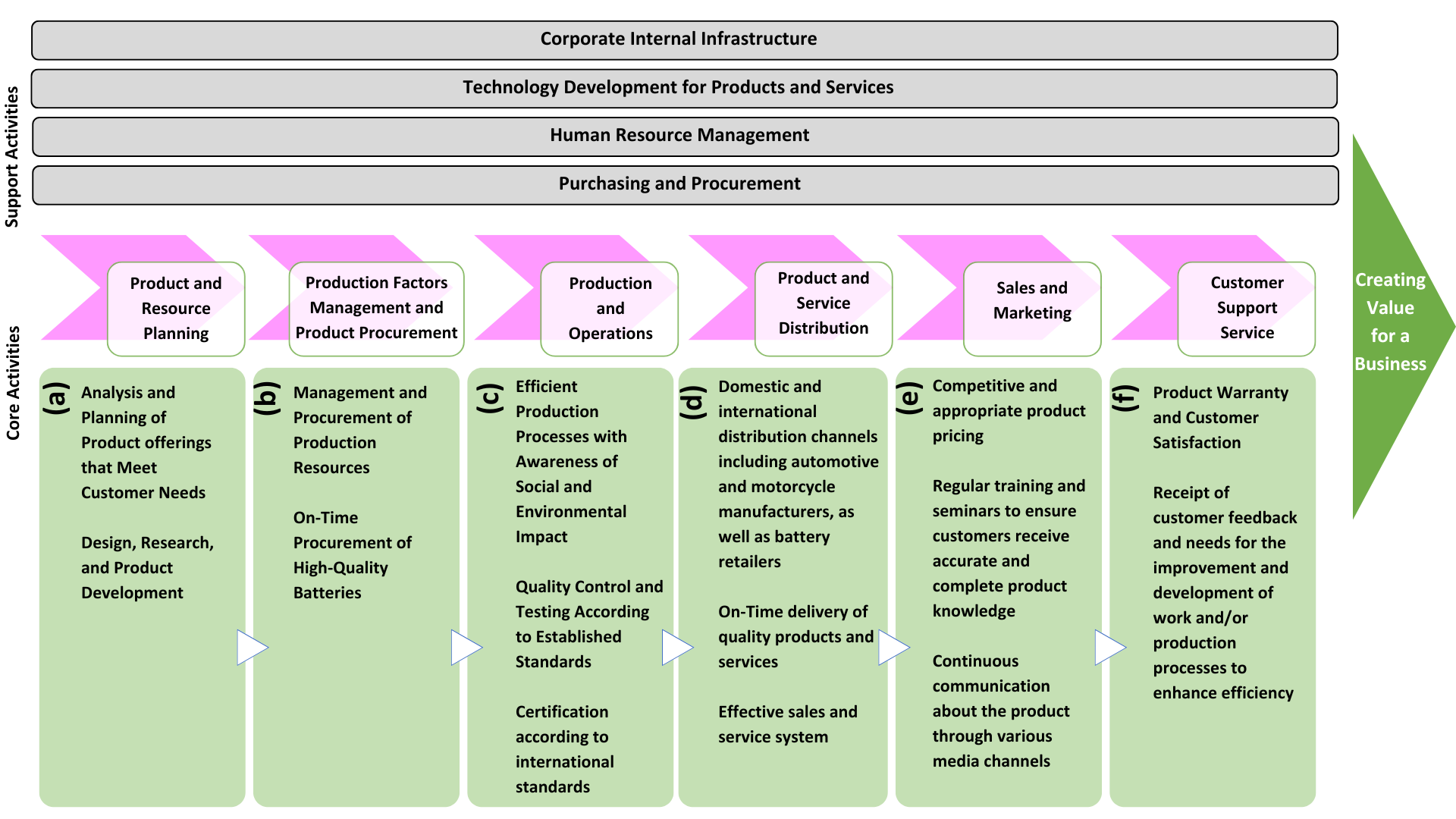
Main Activities: The Company is the manufacturer, importer and distributor of automobile batteries, motorcycle batteries, and other types of batteries, such as deep cycle batteries, for customers in the domestic REM, OEM and export markets. The production is facilitated with technology transfer from GS Yuasa International Ltd., Japan (GYIN), a joint venture partner, with the core activities that are initiated from planning of product offerings to ensure that it aligns with customer needs for resource allocation, procurement of raw materials and finished goods of high quality, and product design and development. The raw materials and production supplies are procured from both domestic and foreign supplies, and the Company also imports batteries for sale apart from production by its own factory. The Customer Service Department was established to provide after-sales services on both products and distribution, defected product claims and complaint and suggestions; all of which will be used in the improvement of the Company’s operation.
Support Activities: These support activities drive the Company’s main activities towards continual and effective operations. They consist of Human Resources Management, Procurement and Purchasing, Technology and IT Development for Products and Services, and Business Infrastructure.
Stakeholder Analysis
Introduction
Stakeholder Analysis
The Company evaluates the Influence and Interest of each stakeholder group to define appropriate engagement approaches and effectively address their expectations. The Company provides opportunities for all stakeholder groups to express their views and to participate appropriately in business processes.
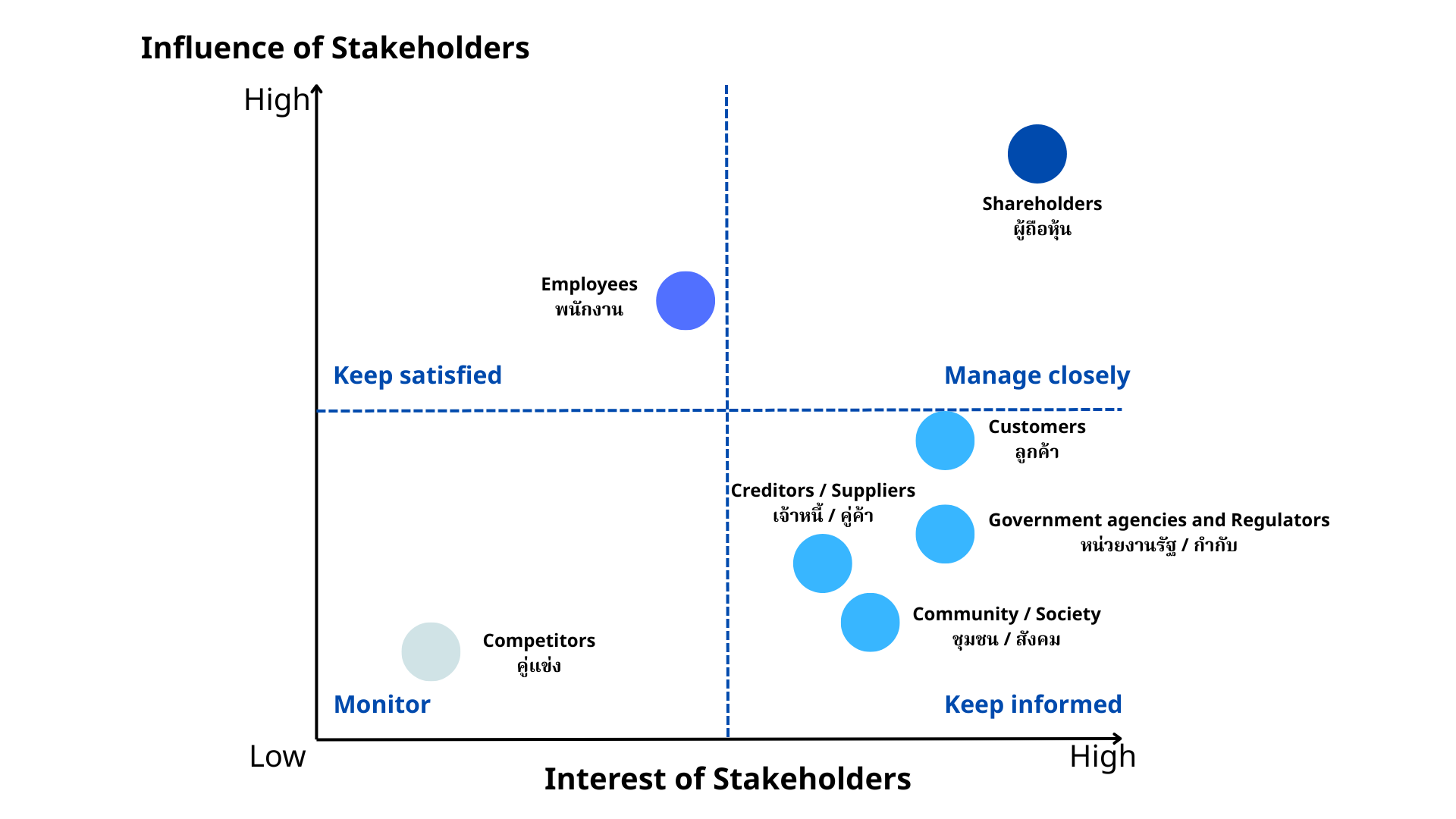
Figure 3.2.2.1 Stakeholder analysis matrix
Materiality Assessment
The Company identifies and prioritizes significant sustainability issues by considering business risks and opportunities, global and industry trends, and the potential impacts on both internal and external stakeholders. The assessment covers Environmental, Social, and Governance (ESG) factors. The findings are used to set policies, action plans, and effective sustainability management targets.
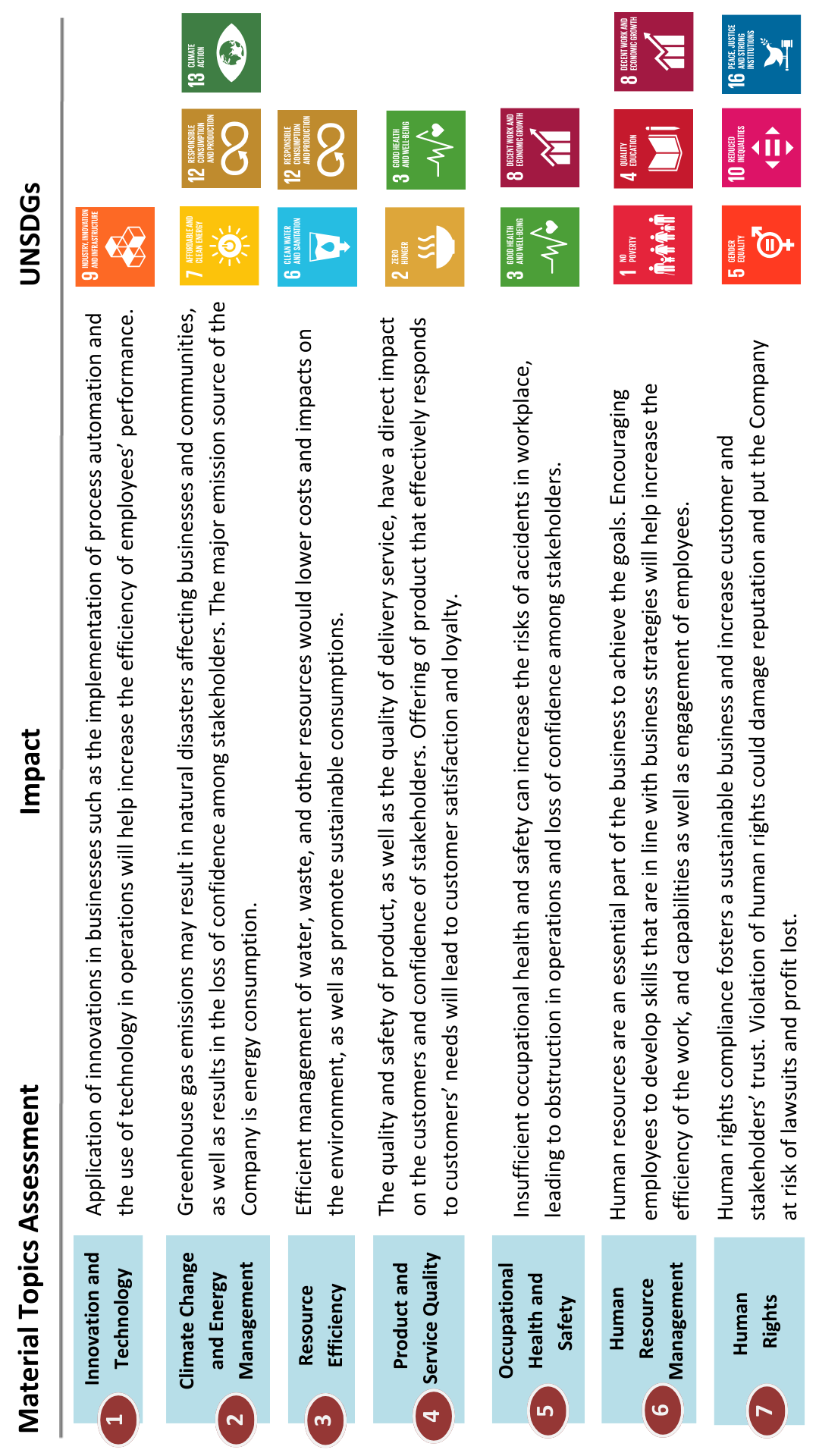
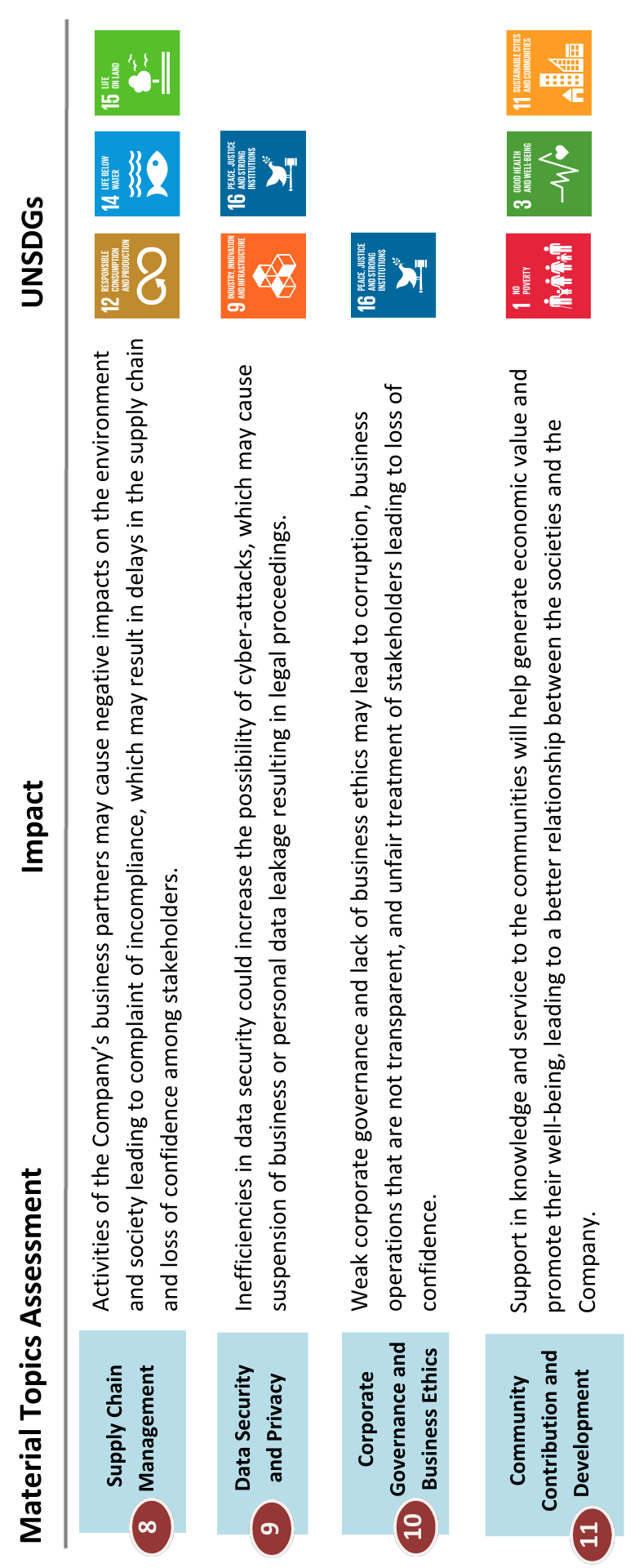
Figure 3.2.2.2 Identification of Materiality and Impacts
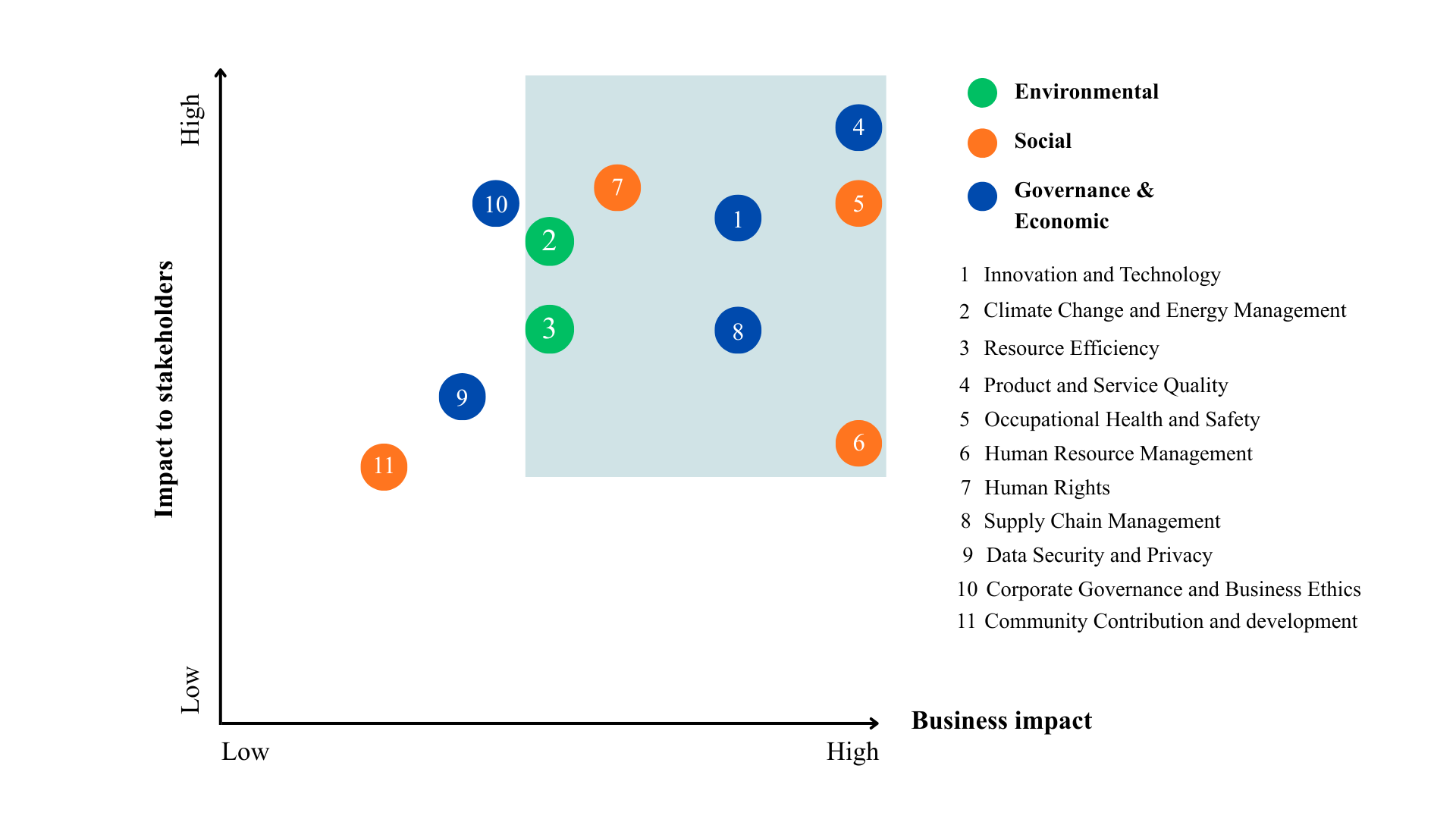
Figure 3.2.2.3 Materiality matrix
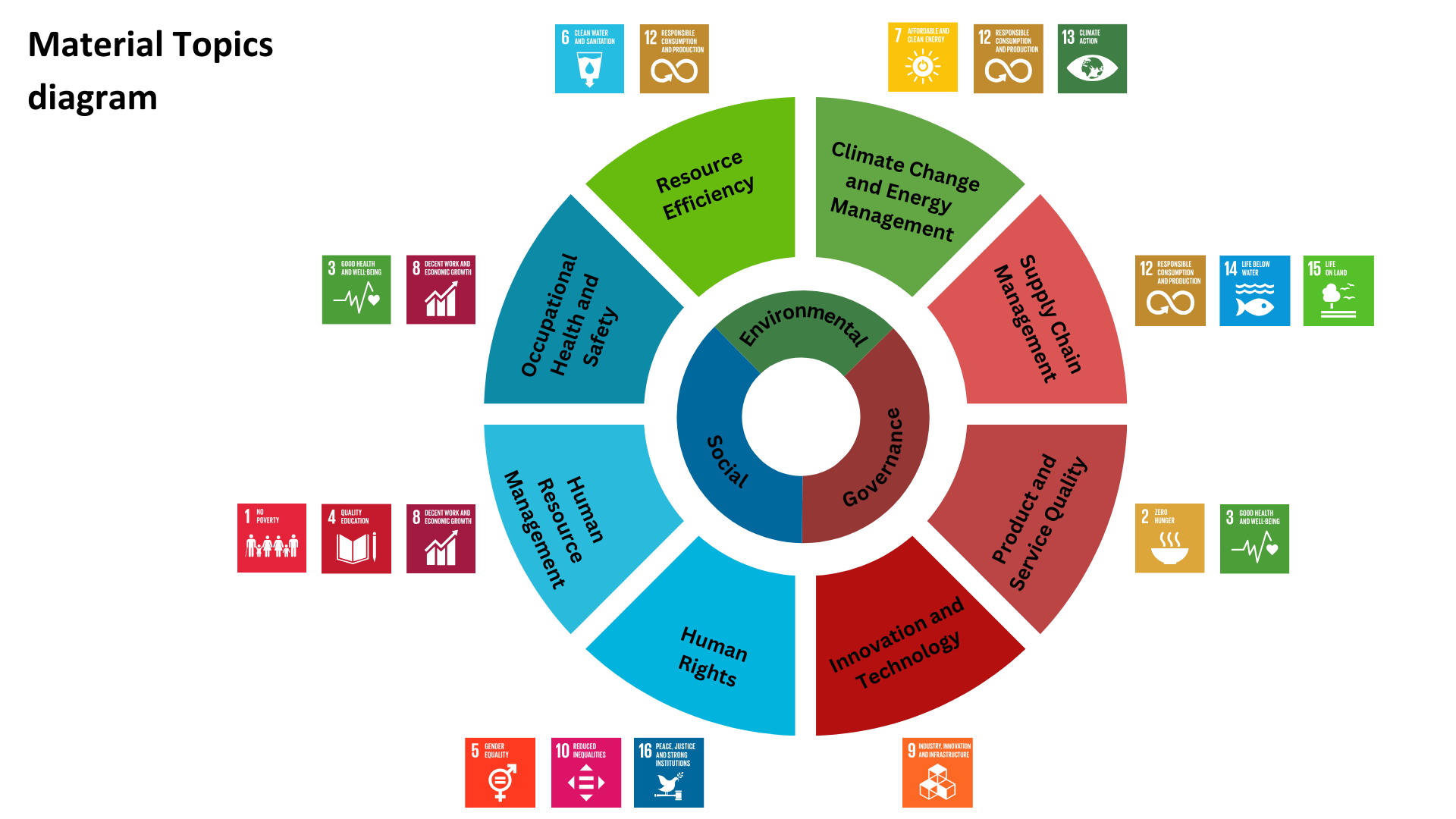
Figure 3.2.2.4 Material Topics diagram
Stakeholder Analysis
| Stakeholder Type | Stakeholders | Stakeholder Expectations | Response to Expectations | Communication Activities |
|---|---|---|---|---|
| Internal stakeholders | 2913 · Description: Shareholders | Continuous growth in performance, return from investments, good governance management and up-to-date and transparent information
| Compliance with good governance code and development of
communication channels for shareholders and institutional investors | 2938 · Description: Visit · 2941 · Description: Online Communication · 2944 · Description: Annual General Meeting (AGM) · 2945 · Description: Complaint Reception · 2947 · Description: Satisfaction Survey |
| External stakeholders | 2923 · Description: Customers | Products with community, social and environmental responsibilities, good quality with reasonable prices, product safety and services, after-sales services, easy and convenient access to products and services, concise product
communication and
complaint handling
| Production, import and sale of quality, standard and safe products, development of sales and service channels, management of complaints with fast and effective actions and offering of equitable before- and after-sales services
| 2941 · Description: Online Communication · 2945 · Description: Complaint Reception · 2947 · Description: Satisfaction Survey · 2948 · Description: Training / Seminar · 2949 · Other name: Communication media · Description: Others |
| Internal stakeholders | 2921 · Description: Employees | Reasonable salary and benefits, good quality of life and occupational safety, career path and stable job, skill, knowledge and capability development for work and employee treatment according
to human rights principles
| Organizational engagement activities, stability and growth opportunity in career path, fair compensation and decent benefits, good and safe work atmosphere and training in skills related to areas of work
| 2942 · Description: Internal Meeting · 2945 · Description: Complaint Reception · 2946 · Description: Employee Engagement Survey · 2948 · Description: Training / Seminar · 2949 · Other name: Internal communication via announcement and intranet system · Description: Others |
| External stakeholders | 2894 · Description: Creditor · 2899 · Description: Suppliers | Transparent and fair trade, reasonable price comparison, development and support for trade partners and compliance with terms and conditions specified in contracts and agreements
| Ethical business conduct, cooperation in development and improvement of quality, equal treatment of all trade partners, clearly defined procurement process, compliance with trading terms and conditions and arrangement of legally valid and transparent contracts
| 2938 · Description: Visit · 2941 · Description: Online Communication · 2943 · Description: External Meeting · 2945 · Description: Complaint Reception · 2947 · Description: Satisfaction Survey · 2948 · Description: Training / Seminar · 2949 · Other name: Business policies and ethics · Description: Others |
| External stakeholders | 2898 · Description: Competitors | Fair competition and non-violation of intellectual properties
| Business conduct with morals and ethics | 2949 · Other name: Business policies and ethics · Description: Others |
| External stakeholders | 2902 · Description: Community · 2928 · Description: Society | Business operation based on safety and social responsibilities, community engagement and support, community development and employment of community members | Participation in activities that promote community culture, promotion of career opportunities of community members and employment in the communities, receipt of feedback from community members and conservation of significant ecosystem of communities surrounding the Company
| 2940 · Description: Social Event · 2941 · Description: Online Communication · 2945 · Description: Complaint Reception · 2949 · Other name: Contact via Operation Departments or other relevant departments · Description: Others |
| External stakeholders | 2931 · Description: Government agencies and Regulators | Support and compliance with all rules and regulations and participation in activities held by government agencies
| Compliance with relevant laws and participation in activities as requested
| 2938 · Description: Visit · 2941 · Description: Online Communication · 2945 · Description: Complaint Reception · 2949 · Other name: Contact via Operation Department or other relevant departments · Description: Others |
Environmental Policy & Guidelines
Introduction
The Company focuses on business growth alongside environmental management, recognizing that its operations may impact the environment or cause pollution. As a result, the company has established an integrated environmental management policy and process, which includes energy management, water management, greenhouse gas management, waste and contaminant management, air quality control, and the effective use of resources.
Has an Environmental Policy
Yes
Policy Description
The Company has defined the environmental policy as follows:
1. Strictly complying with laws, regulations and requirements associated with the environment.
2. Defining management plans that incorporate preventive measures for environmental problems relating to water pollution, air pollution, waste, and noise to minimize the impact on environment. Periodical reviews are to be implemented as appropriate.
3. Encouraging the effective use of energy and natural resources, encouraging energy-saving and waste management activities through 3R (Reuse, Reduce and Recycle) with appropriate management measures.
4. Regularly and continuously improving the environmental management system to mitigate environmental impact risks. Publicizing this policy among employees and stakeholders for their understanding and disclosing it to the public.
Policy Document Link
https://www.yuasathai.com/standardsystem_en
Environmental Guidelines
| Guideline |
|---|
| Electricity Management |
| Fuel Management |
| Renewable/Clean Energy Management |
| Water Management |
| Waste Management |
| Greenhouse Gas and Climate Change Management |
| Air Quality Management |
Environmental Policy Review
Policy Reviewed This Year
Yes
Review Details
Over the past year, the Company established greenhouse gas (GHG) management targets based on GHG intensity (emissions per unit of production). This marks a transition from previous targets which are based on electricity and LPG consumption—the primary emission sources. Furthermore, the Company has revised its external water withdrawal targets. Both adjustments to the environmental goals are integral components of the Company's medium-term plan for 2026–2028.
Policies & Guidelines Changed
| Change |
|---|
| Water Management |
| Greenhouse Gas and Climate Change Management |
Energy — Plan & Guidelines
Introduction
The Company is committed to conducting business together with efficient energy management which helps curb the impact on the environment with the implementation of the Sustainable Use of Resources principles. The Company also carries out the Climate Change Mitigation and Adaptation, which involves the improvement of work process, machinery and equipment in accordance with energy conservation efforts.
Has an Energy Management Plan
Yes
Plan Description
Management roadmap:
1) Complying with requirements, laws and international standards
2) The Company has continuously reduced diesel consumption by replacing diesel forklifts with electric ones. The move helps minimize diesel consumption and reduces combustion, which is another contributing factor to environmental impact. Diesel will still be used for machinery and equipment, but only for the factory’s fire pump systems.
3) The Company has established long-term plans to limit the use of LPG — the improvement of machinery for complete combustion, the replacement of furnace insulations to reduce losses of heat, etc.
4) The Company has improved and replace equipment of electrical, lighting and air-conditioning systems, both in the factory and the office, to reduce the use of public electricity. This also includes the regular repair and maintenance process in relevant to electrical control equipment which helps minimize the use of electricity: the reduction of compressed air pressure in air compressors, the installation of inverters in dust collectors and the replacement of all light bulbs in the Company with LED light bulbs, etc.
5) The Company utilizes renewable energy by installing a solar power system on the factory roof (Solar Rooftop) to reduce electricity consumption from external sources.
Energy — Electricity Consumption
Electricity Consumption
| Metric | Current Year | Previous Year | Two Years Ago |
|---|---|---|---|
| Total electricity consumption within the organization (Kilowatt-Hours) | 20,197,634 | 20,222,346 | 19,590,744 |
| Electricity purchased for consumption from non-renewable energy sources (Kilowatt-Hours) | 18,872,000 | 19,142,977 | 19,285,000 |
| Electricity purchased or generated for consumption from renewable energy sources (Kilowatt-Hours) | 1,325,634 | 1,079,369 | 305,744 |
Energy — Fuel Consumption
Fuel Consumption
| Metric | Current Year | Previous Year | Two Years Ago |
|---|---|---|---|
| Crude oil (Barrels) | |||
| Coal (Metric tonnes) | |||
| Jet fuel (Litres) | |||
| Diesel (Litres) | 8,313 | 7,647 | 7,784 |
| Gasoline (Litres) | 14,633 | 16,431 | 17,049 |
| Fuel oil (Litres) | |||
| Natural gas (Standard cubic feet) | |||
| LPG (Kilograms) | 905,882 | 984,730 | 1,055,240 |
| Steam (Metric tonnes) |
Energy — Targets
Has Set Targets
Yes
Targets
| Target | Base Year | Base Year Value | Target Year | Target Year Value | Target Change (%) | Unit | Unit — Please Specify | Per Unit (Intensity) | Per Unit — Please Specify |
|---|---|---|---|---|---|---|---|---|---|
| Reduction of electricity purchased for consumption | 2,024 | 4.19 | 2,028 | 3.37 | 20 | Kilowatt-hour | Piece of product | Piece of product | |
| Reduction of fuel consumption | 2,024 | 215.6 | 2,028 | 164.4 | 24 | Others | grams | Piece of product | Piece of product |
Energy — Performance & Outcomes
Has Performance Results
Yes
Performance Description
In 2025, the solar power system generated 1,325,634 kilowatt-hours of electricity. With a total external electricity consumption of 18,872,000 kilowatt-hours, the Company achieved cost savings of approximately 5.3 million baht based on an electricity rate of 4 baht per kilowatt-hour. The purchased electricity intensity for 2025 was 3.91 kilowatt-hours per unit of product, representing a 7% reduction compared to the base year. Additionally, other energy-saving initiatives contributed to a further reduction of 142,626 kilowatt-hours. These projects included repairing air leaks in machinery, upgrading to inverter air conditioners, optimizing battery recharging processes, enhancing RO water system efficiency, replacing motors in air treatment and dust collection units, and upgrading motorcycle battery chargers for better energy efficiency.
Regarding fuel consumption, the Company implemented LPG reduction initiatives in 2025. This involved upgrading the insulation for 11 lead grid melting furnaces to minimize heat loss and lower workplace temperatures, alongside a project to optimize machinery for complete combustion. Combined, these projects reduced LPG consumption by 107,121 kilograms of LPG per year, resulting in approximately 2.4 million baht in fuel cost savings (calculated at an LPG price of 22.8 baht per kilogram). In 2025, the LPG intensity per unit of product was 188 grams, representing a 13% reduction compared to the base year.
Water — Plan & Guidelines
Introduction
The Company places importance on the efficient use of water. In all operations, the Company uses tap water and recycled water, recognizing the importance of water, conserving the resource and making the best use of it.
Has a Water Management Plan
Yes
Plan Description
Management roadmap:
The Company manages the use of water for washing and production in both the office and the factory. The Company strives to reduce the use of city water, for which the Environment and Energy Department will inspect the water pipes, industrial cleaning equipment and water meters on a monthly basis and seek more utilizations of recycled water every year. For example, machinery that requires the use of city water will use recycled water instead, and the efficiency of the Reverse Osmosis (RO) water production system used in the battery manufacturing process is being improved to reduce the consumption of incoming city water. In addition, in case where the improvement is needed or the Company is in need of using more water, water-saving devices will be used or installed — water-saving toilets, urinals, automatic taps, etc.
Furthermore, the Company has been operating the project aimed at reducing wastewater to be discharged to the environment. After treatment, the recycled water can be used for watering plants, cleaning the factory’s floor or walkways, helping reduce the use of city water.
Water — Withdrawal, Discharge & Consumption
Water Withdrawal, Discharge & Consumption
| Metric | Current Year | Previous Year | Two Years Ago | Remark |
|---|---|---|---|---|
| Total water withdrawal (Cubic meters) | 122,104 | 164,605 | 173,277 | The methodology for reporting total water withdrawal has been revised from the previous year to exclude treated and reclaimed water. This total withdrawal figure excludes unmeasurable sources, such as rainwater harvested into the system. |
| Total water withdrawal by third-party water (Cubic meters) | 122,104 | 164,605 | 173,277 | |
| Total water withdrawal by surface water (Cubic meters) | 0 | |||
| Total water withdrawal by groundwater (Cubic meters) | 0 | |||
| Total water withdrawal by seawater (Cubic meters) | 0 | |||
| Total water withdrawal by produced water (Cubic meters) | 0 | |||
| Percentage of wastewater treated before discharge (%) | 100 | 100 | 100 | |
| Total water discharge (Cubic meters) | 122,104 | 97,376 | 75,649 | The actual measured wastewater discharge volume for 2025 totalled 129,177 cubic meters, which exceeds the volume of city water entering the system. This is due to inflows from unmeasurable sources, such as harvested rainwater. |
| Total water discharge to third-party water (Cubic meters) | ||||
| Total water discharge to surface water (Cubic meters) | ||||
| Total water discharge to groundwater (Cubic meters) | ||||
| Total water discharge to seawater (Cubic meters) | ||||
| Total water consumption (Cubic meters) | 0 | 67,229 | 97,628 | |
| Recycled water (Cubic meters) | 67,409 | 81,125 | 93,434 |
Water — Targets
Introduction
Regarding 2025 operations, the Company planned to reduce city water intensity to less than 0.01067 cubic meters per kilogram of lead, with a target of no more than 0.027 cubic meters per unit of product. For 2026, the Company has set a more stringent target of 0.0095 cubic meters per kilogram of lead. Furthermore, as part of the medium-term plan (2026–2028), the total city water consumption has been capped at 124,198 cubic meters per year.
Has Set Targets
Yes
Targets
| Target | Base Year | Base Year Value | Target Year | Target Year Value | Target Change (%) | Unit |
|---|---|---|---|---|---|---|
| Reduction of water withdrawal | 2,024 | 164,605 | 2,028 | 124,198 | 25 | Cubic meters |
Water — Performance & Outcomes
Has Performance Results
Yes
Performance Description
In 2025, the Company’s city water withdrawal was 122,104 cubic meters, representing a 26% decrease from the previous year. Between 2023 and 2025, withdrawal of city water declined by an annual average of 16%. The city water consumption intensity was 0.0095 cubic meters per kilogram of lead, outperforming the established target. This improvement was primarily driven by the RO (Reverse Osmosis) system upgrade, which boosted production efficiency from 13% to 43%, alongside increased process water recycling. These initiatives collectively reduced city water demand by 55,148 cubic meters per year.
The Company consistently maintains and inspects its water distribution systems across both production and office areas to ensure they meet standard requirements. Office facilities have been upgraded with water-saving sanitary fixtures. Furthermore, the Company demonstrated effective wastewater management; in 2025, 100% of the water discharged was treated, and a total of 67,409 cubic meters of treated water was reclaimed and reused for production processes, sanitation, and general utilities within the facilities.
Waste Management — Overview
Introduction
The Company has a policy to appropriately and systematically manage garbage and waste in the factory. The disposal has no effect on the communities and environment, while the principles of which comply with the laws. Garbage and waste are from the production, operations and the employees. The Company is committed to reducing the disposal of garbage, waste and pollution from production and other operations.
Waste — Plan & Guidelines
Has a Waste Management Plan
Yes
Plan Description
Management roadmap:
The Company has clear methods of garbage and waste sorting. Garbage and waste are divided into 5 categories: material waste, general waste, organic waste, industrial waste and infectious waste. The details and management of these garbage and waste are as follows:
• Material waste: Waste and rubbish that are from the Company’s operation. They are product boxes and cartons made of cardboard paper or wood, plastic cable ties, iron tie wire, plastic paint buckets and scrap metal. The Company will sell this type of waste to the local scrap buyers and organizes price bidding every month.
• Organic waste: Organic waste is leftovers from the canteen, which usually come in a small quantity. The Company will sort the leftovers and provide for employees who want them for pet food or the making of organic fertilizer. The rest of the waste will be disposed of separately in a green bag and kept in a waste storage, after which the responsible municipality office will collect the waste and dispose of it according to the sanitary principles.
• Infectious waste: i.e., face masks, bandages and cotton in the Company’s infirmary. The Company requires this type of waste be encapsulated in an “infectious waste bag.” The medical personnel at the infirmary will send the waste to the hazardous waste disposal service providers with a license given by the Ministry of Public Health.
• Industrial waste and hazardous sludge: The Company classifies these types of waste into 2 categories. For sludge from wastewater treatment and waste from production, such as soldering paste, lead-contaminated fabric gloves, soil sludge from wastewater treatment, the Company will use the service from hazardous waste disposal service providers with a license given by the Department of Industrial Works, after which the waste will be disposed of with the regulated methods. In case of dross from lead defining process, the Company will sell them to the metal smelting factories with license given by the Department of Industrial Works. The Company also organizes price bidding every month.
• General waste: The Company requires general waste to be sorted and kept in the waste storage areas, after which the responsible municipality office will collect the waste and dispose of it according to sanitary principles.
Waste — Generation, Disposal & Recycling
Waste Generation, Disposal & Recycling
| Metric | Current Year | Previous Year | Two Years Ago |
|---|---|---|---|
| Total waste generated (Kilograms) | 1,550,329 | 1,564,806 | 1,533,850 |
| Non-hazardous waste (Kilograms) | 67,409 | 87,017 | 43,200 |
| Non-hazardous waste - Landfilling (Kilograms) | |||
| Non-hazardous waste - Incineration (with energy recovery) (Kilograms) | |||
| Non-hazardous waste - Incineration (without energy recovery) (Kilograms) | |||
| Non-hazardous waste - Other disposal operations (Kilograms) | |||
| Hazardous waste (Kilograms) | 1,482,920 | 1,477,789 | 1,490,650 |
| Hazardous waste - Landfilling (Kilograms) | |||
| Hazardous waste - Incineration (with energy recovery) (Kilograms) | |||
| Hazardous waste - Incineration (without energy recovery) (Kilograms) | |||
| Hazardous waste - Other disposal operations (Kilograms) | |||
| Total reused/recycled waste (Kilograms) | |||
| Reused/Recycled non-hazardous waste (Kilograms) | |||
| Reused non-hazardous waste (Kilograms) | |||
| Recycled non-hazardous waste (Kilograms) | |||
| Reused/Recycled hazardous waste (Kilograms) | |||
| Reused hazardous waste (Kilograms) | |||
| Recycled hazardous waste (Kilograms) |
Waste — Targets
Has Set Targets
No
Waste — Performance & Outcomes
Has Performance Results
Yes
Performance Description
In 2025, the Company generated a total of 1,550.33 tons of both hazardous and non-hazardous waste. The Company engages licensed hazardous waste disposal contractors accredited by the Department of Industrial Works (DIW). Initiatives implemented to manage production waste included improving the dewatering/compaction of wastewater treatment sludge to reduce moisture content in hazardous waste and optimizing the pasting machine to minimize process waste generation. Additionally, the Company conducts environmental quality monitoring—at least twice a year—within office premises and surrounding operational areas. In 2025, air quality standards, odour, noise levels, and lighting conditions were all found to be within legal limits. Furthermore, there were no reported incidents of chemical spills resulting from business operations.
The Company is implementing a medium-term plan to reduce hazardous waste by recycling by-products from production. Additionally, to minimize waste, the Company has introduced a paper reduction project in the office, utilizing both operational practices and technology to reduce paper-based processes. The Company also launched a waste segregation project, which has expanded to nearby communities. The Company trains local residents, educating them about waste types, and provides them with segregation bins to help recycle and sell waste, generating income for the community.
GHG — Plan & Guidelines
Introduction
The Company is dedicated to addressing climate change by focusing on reducing greenhouse gas emissions from its operations and stakeholders.
Has a GHG Management Plan
Yes
Plan Description
Management roadmap:
1) Use of Renewable Energy: The Company recognizes the importance of harnessing natural energy for its various benefits. This project provides various advantages, especially as it has no environmental impact and helps reduce internal costs. The Company has implemented a solar power installation project in 3 areas within the factory, including:
1.1 Installation of Solar Panels on the Roof: Solar panels have been installed on the roof of the prayer room and the restroom area on the ground floor of Building 3. This project has been in place since 2015, and over the duration of operation, it has generated approximately 0.8-1.75 megawatt-hours of electricity per year.
1.2 Installation of Solar Panels on Factory Roofs: Solar panels have been installed on the roofs of both the factory and office buildings, covering a total of 7 buildings. The installation was completed in October 2023, with a total capacity of 907.06 kilowatt.
1.3 Installation of Solar Panels at the Wastewater Treatment Plant: Solar panels have been installed at the wastewater treatment plant, with the installation completed in September 2024, and a total capacity of 43.1 kilowatt.
2) Improvement of Work Processes, Machinery, and Equipment for Efficient Resource Use: This focuses on the main sources of greenhouse gas emissions within the Company in Scope 1, including electricity usage and LPG fuel. In addition to increasing the use of electricity from renewable energy sources, the Company has enhanced machinery to improve productivity and reduce waste in the manufacturing process. The Company has also made adjustments to production processes and equipment and installed a centralized control system to optimize energy consumption.
3) Use of Electric Forklifts and Electric Stackers: Due to the daily operations of the company, which involve the movement, storage, and issuance of goods, the use of forklifts is necessary for convenience, speed, and labour savings. In the warehouse area, the company has designated the use of electric stackers, while in the factory area, electric forklifts are used for operations. Since 2018, the Company has implemented a policy to replace fuel-powered forklifts that have reached the end of their service life with electric forklifts. This decision stems from the awareness that, although fuel-powered forklifts offer operational convenience, the combustion of fuel in the engine produces dust and exhaust fumes, contributing to pollution and greenhouse gas emissions, thereby impacting air quality. In contrast, the operation of electric forklifts and electric stackers does not have any environmental impact.
GHG — Emissions
GHG Emissions
| Metric | Current Year | Previous Year | Two Years Ago |
|---|---|---|---|
| Total GHG emissions (Metric tonnes of carbon dioxide equivalent) | 12,310.03 | 12,693.17 | 12,985.46 |
| Total greenhouse gas emissions 1 (Metric tonnes of carbon dioxide equivalent) | 2,875.92 | 3,123.6 | 3,344.89 |
| Total greenhouse gas emissions 2 (Metric tonnes of carbon dioxide equivalent) | 9,434.11 | 9,569.57 | 9,640.57 |
| Total greenhouse gas emissions 3 (Metric tonnes of carbon dioxide equivalent) |
GHG — Emissions Verification
Introduction
The Company's greenhouse gas emissions data has not yet been verified. However, there are plans to conduct a greenhouse gas emissions verification according to international standards or equivalent for 2026 operation.
Emissions Verified by a Third Party
No
GHG — Principles & Standards
Principles & Standards Applied
| Standard |
|---|
| 2671 |
GHG — Targets
Has Set GHG Targets
Yes
GHG Targets — Other Targets
Other GHG Targets
| Emission Scope | Base Year | Base Year Emissions | Near-term Target Year | Near-term Target Value | Near-term Target Change (%) | Target Year | Target Year Emissions | Target Change (%) | Unit | Per Unit (Intensity) | Per Unit — Please Specify |
|---|---|---|---|---|---|---|---|---|---|---|---|
| 2715 | 2,024 | 1.02 | 2,028 | 0.89 | 12 | 2,028 | 0.89 | 12 | Metric tonnes of carbon dioxide equivalent | Metric ton of raw material | Metric ton of raw material |
GHG — Performance & Outcomes
Has Performance Results
Yes
Performance Description
The Company prioritizes greenhouse gas (GHG) management to mitigate climate impact. The business activities' most significant emission sources are electricity consumption from production and offices, and LPG consumption in manufacturing processes. To reduce emissions, various measures have been implemented, including decreasing diesel consumption, controlling LPG usage, upgrading electrical equipment, and generating electricity from solar power, among others. In 2025, the Company's Scope 1 (direct) GHG emissions were 2,875.92 tons of CO2 equivalent, and Scope 2 (indirect) emissions were 9,434.11 tons of CO2 equivalent, totalling 12,310.03 tons of CO2 equivalent. Excluding direct emissions from diesel and gasoline for vehicles (data collection began in 2023), year-over-year changes showed a positive downward trend: an increase of 1.4% in 2023, a decrease of 2.2% in 2024, and a further decrease of 3.0% in 2025. Furthermore, the GHG intensity (per ton of lead raw material) from primary sources in 2025 was 0.95 tons of CO2 equivalent, representing a 7% reduction from 2024 and keeping the Company on track with the strategic plan.
The Company has executed numerous energy-saving projects between 2019 and 2025. The medium-term plan through 2028 outlines further energy initiatives:
Electricity Reduction: Improving equipment and machinery efficiency, installing additional solar cells, and optimizing the work environment to reduce A/C usage.
LPG Reduction: Enhancing machinery and processes to minimize energy loss and reusing waste materials and heat within the production process.
Environmental Legal Incidents
Legal Violation Incidents
| Metric | Current Year | Previous Year | Two Years Ago |
|---|---|---|---|
| Number of cases or incidents of legal violations or negative environmental impact (cases) | 0 | 0 | 0 |
Other Environmental Management
Plan — Introduction
The Company has established clear quantitative goals not only for managing energy, greenhouse gas emissions, and resource use but also for reducing pollution associated with its operations. These goals focus on controlling lead levels in the air and in water discharged from the factory after treatment. In addition, the Company has outlined plans to surpass these targets, integrating them into its annual business plan to ensure continuous improvement.
Plan Description
In 2025, the Company’s operations for managing environmental aspects other than energy management, water management, garbage and waste management, and greenhouse gas emissions are as follows:
- Lead in Air Management: In 2025, the Company aims to reduce lead in air levels to no more than 0.03 milligrams per cubic meter, which is below the legal standard of 0.05 milligrams per cubic meter. Efforts have been made to improve production machinery and working methods to minimize the dispersion of lead dust, as well as to enhance the performance of air treatment and dust collection equipment. Throughout the year, monitoring results showed that the average lead in air concentration was 0.02 milligrams per cubic meter.
- Lead in Treated Water Management: The Company has an ongoing plan to monitor and track lead levels in the treated water discharged from the factory. The Company's target is to keep lead concentration below 0.10 milligrams per litre, which is lower than the standard set by the Department of Industrial Works at 0.20 milligrams per litre. In 2025, the lead concentration in treated water met the Company's target.
Employees — Plan & Guidelines
Has an Employee Management Plan
Yes
Plan Description
The Company is committed to managing human resources based on the Good Governance principles by specifying human resources strategies, starting at recruitment process, human resources development and employee retention. The Company also supports employees with equal growth opportunity and career path regardless of gender, race and religion, committed to improving knowledge and capabilities and encouraging employees to have voluntary attitudes and contribute towards the society and the public as stipulated in the Company’s human resources management policy.
Recruitment process: The Company must plan to recruit employees to support operations. The Company has specified the employment policy by promoting the employment of the residents of Samutprakan, supporting the development of the local economy and workforces. The Company also offers job opportunities for the underprivileged by joining forces with and supporting the employment policy of government agencies, e.g., the employment of people with disabilities. The Company places importance on and supports the employment of people with disabilities, complying with the Empowerment of Persons with Disabilities Act B.E. 2550 and Article 33 of its amendment (No.2) B.E. 2556. The Company offers careers and responsibilities that are suited with the workforces’ capabilities and potential.
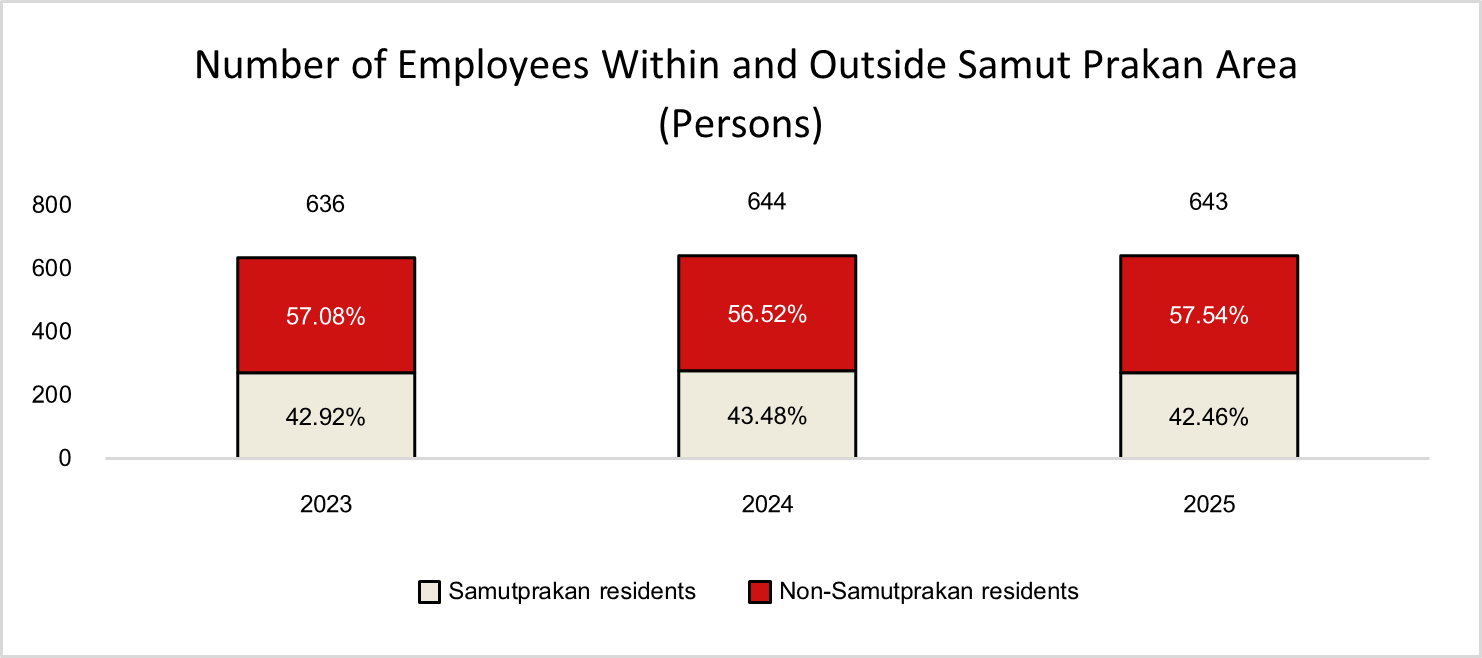
Source: The Human Resources Department, Yuasa Battery (Thailand) PLC
Figure 3.4.2.1 Employment of Samutprakan residents
Employee compensation and welfare management: The Company has established a compensation management and welfare policy for employees with fairness and without discrimination, in line with the economic situation and working areas, ensuring that employees receive sufficient compensation for their living. Apart from paying out higher average wages than the minimum stipulated by laws, the Company provides other welfares for employees, e.g., position allowance, diligence allowance, provident fund, accident insurance, staff uniforms, employee welfare fund, hospitalized gifts, childbirth celebration gifts and funeral support expenses for employees and their family. For employees whose years of service are over 5 years, the Company will present awards to them for having helped drive the Company to its growth for more than 60 years.
Trainings and employee development: The Company places great importance on developing employee potential and enhancing work effectiveness by selecting courses that align with the nature of the business and external factors that may impact it at a given time. In the past year, the Company organized training sessions for 671 employees, totalling 4,194 hours. The total training cost amounted to 1,067,146.71 baht.
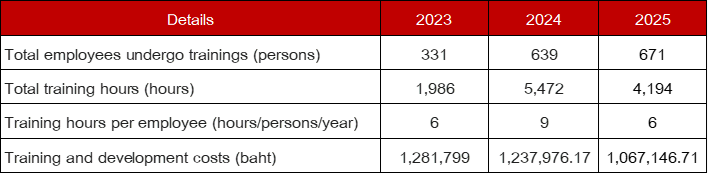
Source: The Human Resources Department, Yuasa Battery (Thailand) PLC
Figure 3.4.2.2 Details of Trainings and employee development
Safety, occupational health and work environment: The Company is aware that good hygiene and safe work environment will help boost employees’ effectiveness at work and increase confidence of all stakeholders. The Company recognizes the importance of the occupational health and work environment management, ensuring safety for employees and all stakeholders. To ensure accident-free operations, the company has set the “Zero Accident” target as a campaign aimed at raising employees’ awareness of the importance, encouraging them to be always fully aware while working and not involving or causing any accidents that might lead to occupational injuries and illnesses.
Plan Areas
| Plan Area |
|---|
| Fair employee compensation |
| Employee training and development |
| Promoting employee relations and participation |
| Occupational health and safety in workplace |
Employees — Workforce
Workforce Data
| Metric | Current Year | Previous Year | Two Years Ago |
|---|---|---|---|
| Total number of employees (Persons) | 643 | 644 | 636 |
| Number of male employees (Persons) | 434 | 435 | 423 |
| Number of female employees (Persons) | 209 | 209 | 213 |
| Total employment of disabled persons (people) | 6 | 6 | 2 |
| Total disabled employees (people) | 2 | 2 | 2 |
| Total male disabled employees (people) | 2 | 2 | 2 |
| Total female disabled employees (people) | 0 | 0 | 0 |
| Total disabled workers who are non-employee (people) | 4 | 4 | |
| Contributions to the fund for promoting and improving the quality of life for disabled persons | 0 | 0 | 1 |
| Total number of male employees in operational level (Persons) | 363 | 368 | 361 |
| Total number of male employees in management level (Persons) | 67 | 63 | 58 |
| Total number of male employees in executive level (Persons) | 4 | 4 | 4 |
| Total number of female employees in operational level (Persons) | 165 | 166 | 173 |
| Total number of female employees in management level (Persons) | 42 | 41 | 38 |
| Total number of female employees in executive level (Persons) | 2 | 2 | 2 |
Employees — Remuneration & Provident Fund
Remuneration & Provident Fund
| Metric | Current Year | Previous Year | Two Years Ago |
|---|---|---|---|
| Total disabled employees (people) | 278,280,781.3 | 269,387,401.4 | 230,210,674 |
| Total male employee remuneration (Baht) | 178,512,028.02 | 174,869,686.4 | |
| Total female employee remuneration (Baht) | 99,768,753.28 | 94,517,715 | |
| Number of employees eligible to participate in PVD (persons) | 579 | 626 | 616 |
| Total number of employees joining employee provident fund (Persons) | 481 | 523 | 509 |
| Percentage of total number of employees joining employee provident fund to total number of employees (%) | 74.81 | 81.21 | 80.03 |
| Number of PVD members / Total eligible employees (%) | 83.07 | 83.55 | 82.63 |
| Total amount of provident fund contributed by the Company (Baht) | 5,586,973 | 5,799,114 | 5,441,340 |
| Total amount of provident fund contributed by employee (baht) | 10,064,210 |
Employees — Training & Development
Training Data
| Metric | Current Year | Previous Year | Two Years Ago |
|---|---|---|---|
| Average employee training hours (Hours / Person / Year) | 6 | 9 | 6 |
| Employee development and training expenses (baht) | 1,067,146.71 | 1,237,976.17 | 1,281,799 |
Employees — Occupational Health & Safety
Occupational Health & Safety Data
| Metric | Current Year | Previous Year | Two Years Ago |
|---|---|---|---|
| Total number of lost time injury incidents by employees (Cases) | 0 | 0 | 0 |
Employees — Labour Relations
Labour Relations Data
| Metric | Current Year | Previous Year | Two Years Ago |
|---|---|---|---|
| Total voluntary resignations (Persons) | 28 | 29 | 36 |
| Male employees who voluntary resigned (Persons) | 24 | 16 | 24 |
| Female employees who voluntary resigned (Persons) | 4 | 13 | 12 |
| Percentage of employee turnover leaving the Company voluntarily (%) | 4.35 | 4.5 | 5.66 |
| Evaluation result of employee engagement | 1 | 1 | 0 |
Employees — Employee Representation
Employees Are Represented Collectively
Yes
Forms of Representation
| Form |
|---|
| Labor union |
Employees — Targets
Has Set Employee Targets
Yes
Targets
| Indicator | Target Areas | Target Year | Target Year — Description |
|---|---|---|---|
| Number of accident occurrence | 2988 · Description: Safety and occupational health at work | 2,028 | Zero accident - all cases |
Employees — Performance & Outcomes
Has Performance Results
Yes
Performance Description
In 2025, the Company implemented measures regarding occupational safety, health, and the working environment by continuously developing and improving safety performance. These efforts aim to reduce the risk of illness, injury, or fatality and to ensure the appropriate quality of life for all staff and employees. Key initiatives are as follows:
1. Expanded training courses and comprehensive employee development: This year, the Company introduced and enhanced specialized safety training programs tailored to specific operational risks that were previously not fully addressed. These include Walking 5 training, X-Lift operation training, confined space operation training, as well as Emergency Response training and drills for LPG and Liquid Oxygen leaks.
2. Hazard Identification and Risk Assessment: The Company has established a monthly schedule for Hazard Identification & Risk Assessment, improving upon the previous inconsistent implementation. This transition enables proactive accident prevention and ensures more rapid problem-solving.
3. Comprehensive Safety Day Activities: The Company expanded Safety Day activities to include the night shift, ensuring equal participation for employees across all shifts and fostering a consistent safety culture throughout the organization.
4. Installation of Safety Gates/Doors: The primary objective is to prevent loss of life and property damage. These gates control unauthorized access and serve as a vital reminder for employees to wear Personal Protective Equipment (PPE) before entering work areas.
5. Tangible Implementation of Lockout Tagout (LOTO) System: The Company provided and installed Lockout Tagout (LOTO) equipment to ensure the isolation of hazardous energy (electrical, pneumatic, and hydraulic) before machine maintenance. This significantly reduces the risk of accidental machine startup and is considered a highly effective control measure.
In 2025, two work-related injuries were reported. In response, the Company implemented the following preventive measures: 1) Developed Work Instructions (WI) and provided training to ensure correct understanding, including maintaining formal training records; 2) Provided appropriate Personal Protective Equipment (PPE) for employees; and 3) Enhanced equipment safety to ensure a safer working environment.
In addition, the Company conducted a survey on employee satisfaction and engagement, with 307 employees participating in the assessment. Of the respondents, 68% were male, 84% had a tenure of five years or more, and 74% were from the production function. The survey results indicated that the average job satisfaction score was 82%, while the average satisfaction with the working environment was 79%, reflecting a high level of satisfaction in both areas and showing an improvement compared to 2024. Employee engagement was rated at a moderate level, with an average score of 3.60, or 72%. When analyzed by dimension, affective commitment was at a moderate level, with an average score of 3.25. Continuance commitment was at a high level, with an average score of 3.83. Normative commitment was also at a high level, with an average score of 3.84. Although the overall employee engagement score in 2025 decreased compared to 2024, the Company revised its survey methodology this year to better align with the present context. Therefore, the results from the two years are not directly comparable. In addition, some respondents provided recommendations for improvements in various areas. The Company will analyze the survey results to develop strategies and review employee care measures in order to enhance employee engagement and satisfaction. Furthermore, the Company has established a target for subsequent years, requiring employee satisfaction and engagement scores to remain at a high level. This is defined as a score of 3.68 or higher out of a total of 5.00, or 74%.
Customers — Plan & Guidelines
Introduction
The Company is committed to managing the offering of products and services to effectively cater to the needs of customers. The actions include manufacturing a wide variety of products to meet the demand of customers. It operates with fairness and prioritizes the highest level of customer satisfaction.
Has a Customer Management Plan
Yes
Plan Description
The Company is committed to manufacturing quality products and offering services to meet the standards with reasonable prices under changes of lifestyle in which products and services are more likely to be purchased online, the trend of eco-friendly product usage, and the fast-approaching ageing society. The Company also improves the quality of the delivery service to effectively respond to the demand of customers. In addition, the Company recognizes the importance of safety and quality of products sold to customers. The Production Department regularly inspects the production quality and is also responsible for requesting product certification from government agencies, such as the Thai Industrial Standards Institute.
The Company is committed to fair marketing by requiring employees to provide truthful information about products and services, without concealing essential details that could lead to misunderstandings and affect customers' purchasing decisions. Employees must advise customers on product usage, potential risks, and preventive measures to avoid harm. The Company also provides after-sales service, offering a period for product claims in case of defects within one year from the date of purchase. If end-users encounter any issues, they must notify the store where they purchased the product so the store can forward the issue to the Company.
The customer relations management roadmap is as follows:
1) Building engagement and relationship with customers in a continuous basis by reaching to and responding to their needs effectively;
2) Committed to delivering quality products and services to build good customer experiences
3) Surveying customer satisfactions and adopting the results in the development and improvement of products and services on an annual basis
4) Developing online sales channels to offer easier and more convenient access to customers
Regarding the protection of personal data, the Company has established the Privacy Policy for customers, trade partners and employees for their acknowledgement of privacy notice, whether it be the collection, use or disclosure, to comply with the Personal Data Protection Act B.E. 2562 (“PDPA”). The policy also defines a code of conduct with strict measures to maintain security of personal data, ensuring that personal data of customers, trade partners and employees will be confidential. If the Company is to use the personal data, the Company will request for consent from the data subject before using the data lawfully as specified in the Company’s Code of Conduct.
Plan Areas
| Plan Area |
|---|
| Responsible production and services for customers |
| Communication of product and service impacts to customers/consumers |
| Development of customer satisfaction and customer relationship |
| Protection of customer personal information |
Customers — Satisfaction Results
Customer Satisfaction Results
| Metric | Current Year | Previous Year | Two Years Ago |
|---|---|---|---|
| Evaluation results of customer satisfaction | 1 | 1 | 1 |
Customers — Targets
Has Set Customer Targets
Yes
Targets
| Indicator | Target Areas | Base Year | Base Year — Description | Target Year | Target Year — Description |
|---|---|---|---|---|---|
| Overall customer satisfaction with products and services | 3009 · Description: Development of customer satisfaction and customer relationship | 2,024 | The overall customer satisfaction score stands at 79%. | 2,028 | The target for overall customer satisfaction is set at 80% or higher. |
Customers — Performance & Outcomes
Has Performance Results
Yes
Performance Description
The Company has a customer satisfaction survey process as well as a process of giving and receiving customer feedback, of which results will be adopted in the continuous enhancement of products and services as well as the Company’s business operations. These are aimed at building impressions and customer satisfactions, encouraging customers to always keep coming back regularly. In 2025, the Company surveyed about customer satisfaction in the domestic replacement market in 5 aspects, namely products and packaging, sales, delivery, marketing and after-sales services. Customers’ overall satisfaction is in the range of 84% or “Excellent.”.
Based on the satisfaction scores in each category and customer suggestions, the Company has utilized the information for improvement of product/ services/ business processes by setting action plans of the relevant departments, such as setting goals and practices for on-time product delivery or adjusting premiums to better meet customer needs. Regarding customer complaints, the Company has not received any complaints from customers.
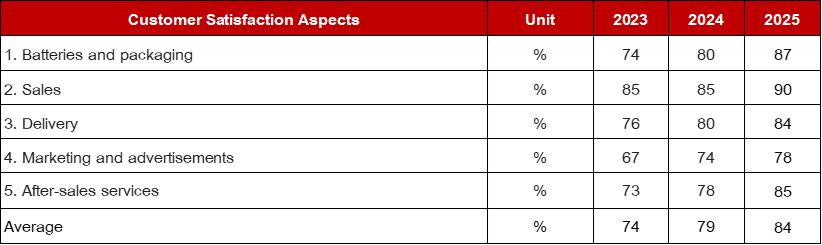
Remarks: 80% or above refers to “Excellent” 70-79% refers to “Good” 60-69% refers to “Moderate” 59% or below refers to “Need improvement”
Source: The Customer Service Department, Yuasa Battery (Thailand) PLC
Figure 3.4.2.3 Customer satisfaction score in the domestic replacement market
Community & Social — Plan & Guidelines
Introduction
The Company acknowledges the role of its involvement in creating value for society. It aims to enhance the quality of life for people in the community and strengthen the local economy, while running its business with a focus on social responsibility. This is based on the principle of creating shared value with stakeholders in a balanced way.
Has a Community & Social Plan
Yes
Plan Description
The Company supports and encourages the use of business processes to create diverse value for society and the environment through various projects and activities. These include efforts to ensure a safe living environment and improve the quality of life for community members, as well as promoting skills and knowledge. The aim is to bring measurable benefits to the community or society.
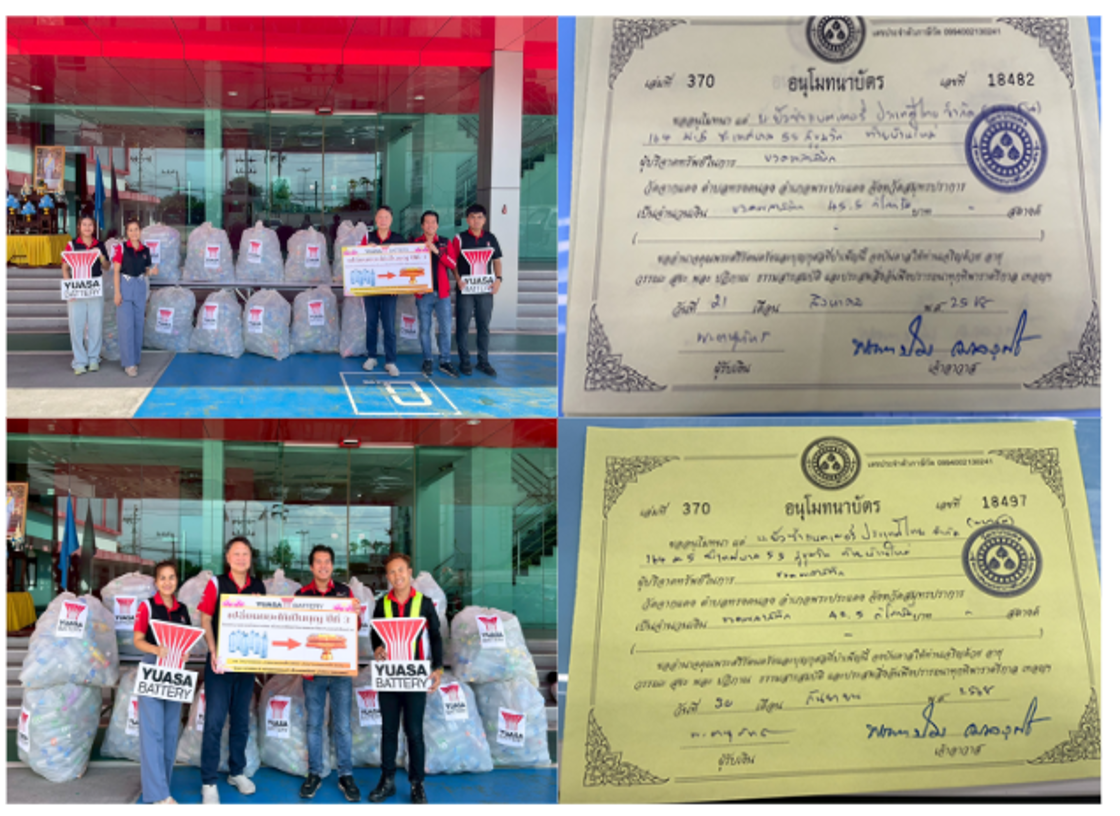
Since 2021, the Company has organized a battery check-up activity for the public in Samut Prakan and nearby areas before the long Songkran holiday each year. The aim is to assess the condition of batteries and provide advice on maintenance to prolong their lifespan. As for other projects undertaken by the Company in 2025, they include the installation of community solar cells, a blood donation drive for border soldiers, and an initiative to recycle plastic bottles into saffron robes. Previously, in 2023, the Company also conducted a training session in the Klong Hua Lamphu community, Samut Prakan, to raise awareness about waste types and provided waste separation bins. The company encouraged recycling, which helped generate additional income for the community. The activity took place from July to August 2023 (8 weeks).
Plan Areas
| Plan Area |
|---|
| Employment and professional skill development |
| Education |
| Religion and culture |
| Forests and natural resources |
| Sports and recreation |
| Occupational health, safety, health, and quality of life |
| Disadvantaged and vulnerable groups |
| Water and sanitation management |
| Reducing inequality and promoting social equality |
Community & Social — Targets
Has Set Community & Social Targets
No
Community & Social — Performance & Outcomes
Has Performance Results
Yes
Performance Description
The battery check-up activity organized by the company during the Songkran festival each year has the following results:
In 2021, the activity was held at the Bangkaew Expressway, Bangna-Chonburi. A total of 47 vehicles were checked each day, helping to reduce the cost of battery check-ups at service centers by 14,100 Baht.
In 2022, the activity was held at the PTT gas station in Paknam, Samut Prakan. A total of 49 vehicles were checked each day, helping to reduce the cost of battery check-ups at service centers by 14,700 Baht.
In 2023, the activity was held at the Lotus department store, Sai Luat branch, Samut Prakan. A total of 52 vehicles were checked each day, helping to reduce the cost of battery check-ups at service centers by 15,600 Baht.
In 2024, the activity was held at the Lotus department store, Sai Luat branch, Samut Prakan. A total of 32 vehicles were checked each day, helping to reduce the cost of battery check-ups at service centers by 9,600 Baht.
In 2025, the activity was held at the Lotus department store, Sai Luat branch, Samut Prakan. A total of 38 vehicles were checked each day, helping to reduce the cost of battery check-ups at service centers by 11,400 Baht.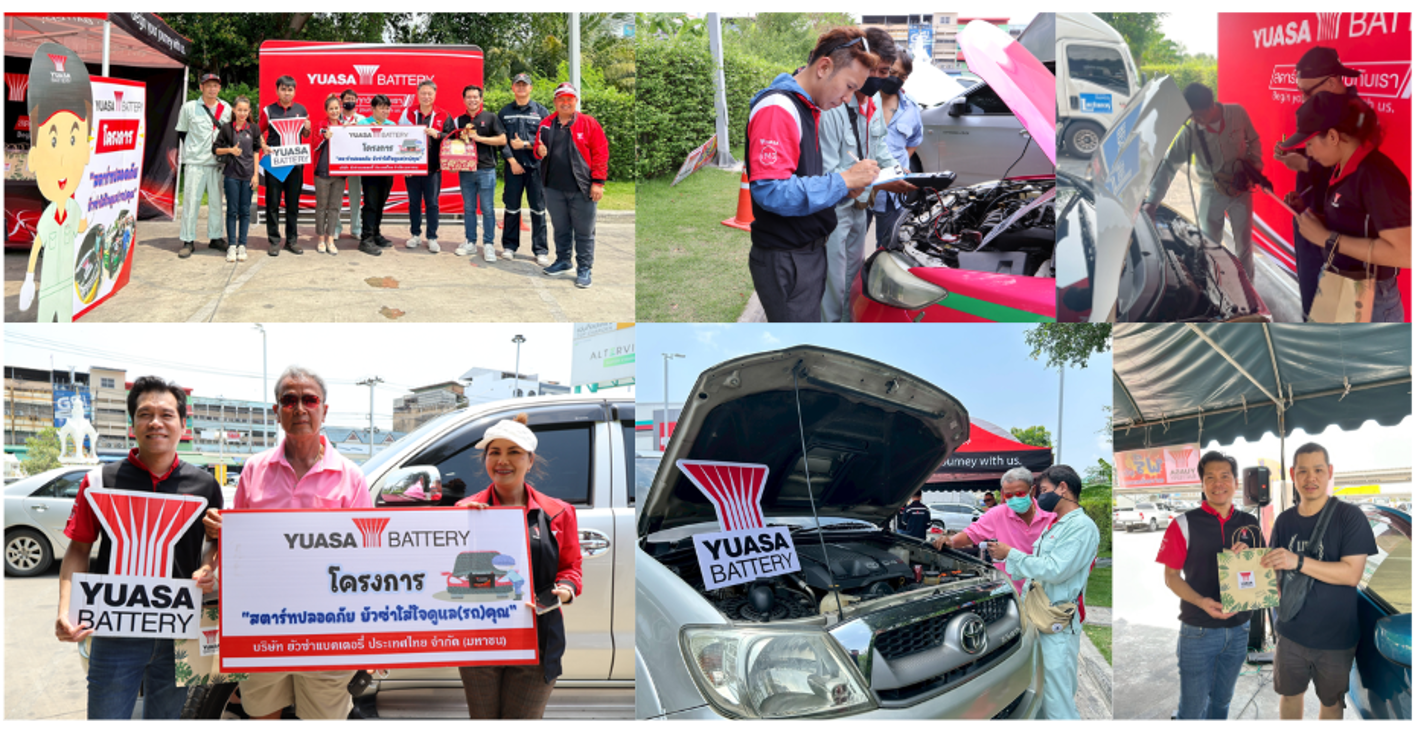
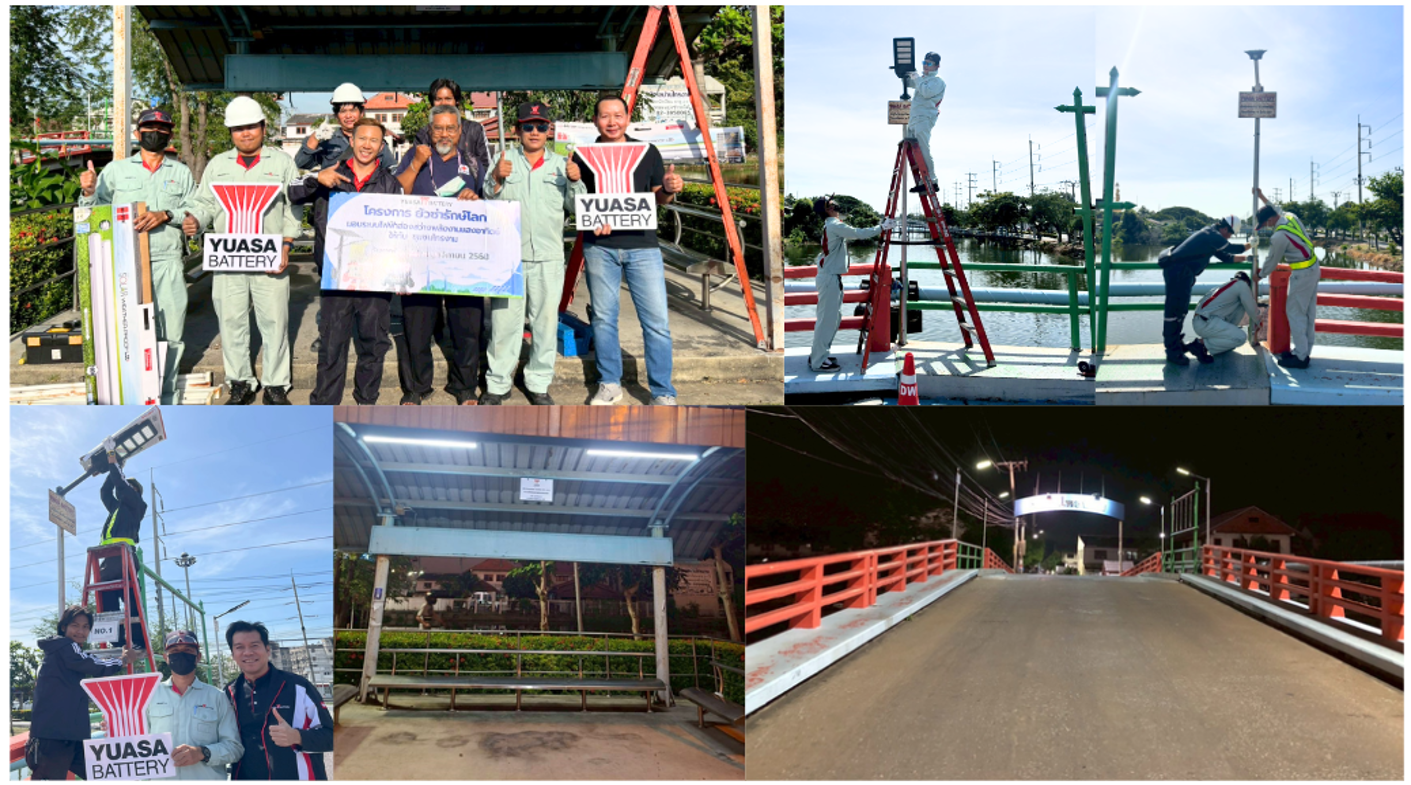
Community Solar Cell Installation Activity In 2025, the Company installed solar cell lighting at 6 locations around the bridge entrance to Sai Ngam Village and the bus waiting area to reduce public electricity consumption and enhance safety for nighttime commuting.
- Reduced electricity costs by 29,502 Baht per year.
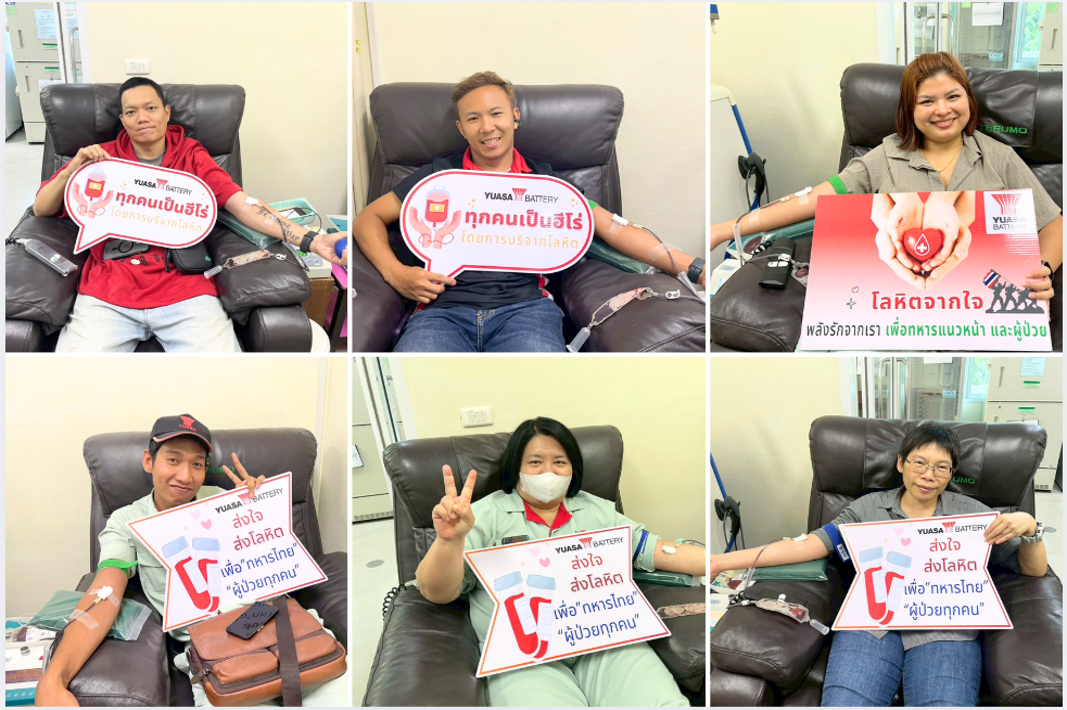
Blood from the Heart for the Border Activity In 2025, the Company organized for employees to participate in blood donation at Samut Prakan Hospital to be provided to soldiers in the 2nd Border Region.
- Number of blood donors: 24 people
- Total blood volume: 10,200 cc (450 cc: 18 bags / 350 cc: 6 bags)
- Able to help 72 patients
Plastic Bottle Waste to Monk Robes for Global Warming Reduction Activity In 2025, the Company organized a plastic bottle waste donation activity within the organization to donate to Wat Chak Daeng, Phra Pradaeng District, Samut Prakan Province.
- 87 kg of plastic bottle waste was woven into 145 monk robes.
- Able to help reduce expenses for the temple by 72,500 Baht.
Law Violation Incidents
Law Violation Incidents
| Metric | Current Year | Previous Year | Two Years Ago |
|---|---|---|---|
| The total number of cases or incidents of significant violations of laws or regulations regarding social and human rights (Cases) | 0 | 0 | 0 |
| The total number of cases or incidents that cause significant labor disputes (Cases) | 0 | 0 | 0 |
| The total number of cases or complaints related to consumer rights violations (Cases) | |||
| The total number of cases or complaints related to partner rights violations (Cases) | |||
| The total number of cases or incidents that cause disputes with the community/society (Cases) | |||
| The total number of cases or incidents related to cyber security or customer data breaches (Cases) | |||
| The total number of cases or incidents related to safety and occupational health at work (Cases) |