

MD&A · 2025
In this section4 topics
Overview of Operations
Overview of Operations
Performance Summary of Year 2025
The Thai economy is showing a clear decelerating trend, following a decline in consumption and income levels. High household debt remains a significant pressure on private consumption. Meanwhile, growth in the automotive industry remains stagnant due to intense competition and weak demand in both domestic and international markets.
In 2025, the Company recorded a significant increase in motorcycle battery production volume, resulting from the production capacity expansion project completed late the previous year. Regarding sales, the automotive battery product line was restructured to better meet market demand. The Company has also continued to focus on enhancing production efficiency, reducing energy and resource consumption, and maintaining standards for Occupational Health, Safety, and Environment. Consequently, the Company reported a net profit of 242.77 million Baht, an increase of 70.35 million Baht or 40.8% compared to 2024.
Table summarizing operating results :
Unit: Million baht | 2025 | 2024 | YoY |
Sales of goods | 2,863.78 | 2,884.31 | (0.7%) |
Cost of sales | 2,084.73 | 2,196.98 | (5.1%) |
Gross margin | 779.05 | 687.33 | 13.3% |
Other income | 14.31 | 5.80 | 146.8% |
Selling and administrative expenses | 517.92 | 491.52 | 5.4% |
Finance cost | 0.50 | 0.55 | (10.2%) |
Income tax expenses | 32.17 | 28.64 | 12.4% |
Net profit | 242.77 | 172.42 | 40.8% |
Earnings per share (Baht/share) | 2.26 | 1.60 | 40.8% |
Operating Results & Financial Condition
Other Analysis
| Title | Description |
|---|---|
| 1. Operating Results | Year 2025 operating results i. Sales of goods: The Company's revenue from sale of goods decreased by 0.7% or 20.52 million baht compared to 2024. This variance was primarily driven by a decline in automotive battery sales to both domestic and international manufacturers resulting from strategic realignments, and a reduction in export revenue. The latter was impacted by the prolonged situation in Myanmar and the Thailand-Cambodia border conflict during the second half of 2025. Furthermore, the economic downturn led to an approximately 3% year-on-year decrease in automotive and motorcycle battery sales to domestic retail business. However, sales revenue from the domestic automotive replacement battery market rose by 18% compared to 2024. This growth was driven by a product line optimization to better align with market demand and enhance competitiveness. Additionally, sales revenue from motorcycle batteries to both domestic and international manufacturers increased slightly from the previous year, as market demand remained stable. ii. Cost of sales: The Company's cost of sales stood at 2,084.73 million baht, representing 72.80% of sales of goods. This reflects a decrease from 76.17% in 2024, primarily driven by a decline in the price of lead—a key raw material—and the appreciation of the Thai Baht against the US Dollar. iii. Selling and administrative expenses: For 2025, the Company recorded total selling and administrative expenses of 517.92 million baht, representing 18% of sales of goods. Compared to 2024, Selling and Administrative (S&A) expenses increased by 26.40 million baht, with the expense-to-revenue ratio increasing by approximately 1%. Selling expenses increased by 10.51 million baht, primarily due to a 4.97 million baht increase in excise tax aligned with higher domestic sales, along with higher local freight and export costs, online media expenses, and sales-related personnel costs. Administrative expenses increased by 15.89 million baht, mainly driven by personnel expenses and costs associated with the implementation of the Enterprise Resource Planning (ERP) system. |
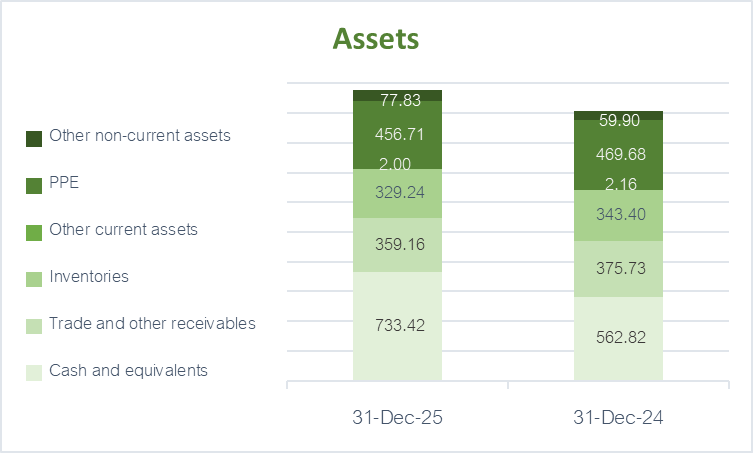
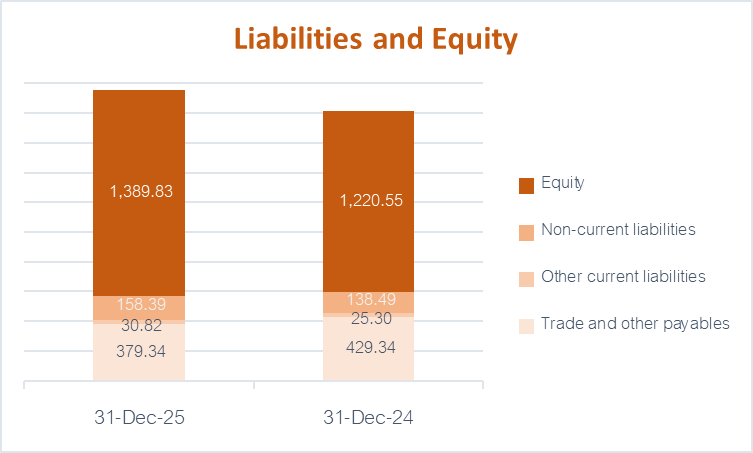
| 2. Financial Position | 2.1) The Company’s total assets as of December 31, 2025 amounted to 1,958.38 million baht, consisting of 1,423.83 million baht in current assets and 534.55 million baht in non-current assets. Current assets increased by 139.73 million baht compared to the balance as of December 31, 2024. Specifically, cash and cash equivalents rose by 170.60 million baht. Beyond the increase in net profit, this growth was primarily driven by a reduction in trade payables, trade receivables, and inventories, resulting from more efficient inventory and raw material management, as well as improved account receivable management. Meanwhile, non-current assets increased by 4.97 million Baht, mainly attributed to the Enterprise Resource Planning (ERP) software which was under implementation in 2025. 2.2) The Company’s total liabilities as of December 31, 2025 amounted to 568.55 million baht, a decrease of 24.57 million baht compared to the balance as of December 31, 2024. This reduction was primarily driven by a 50.00 million baht decrease in trade payables and other current payables, while other current liabilities remained relatively stable. On the other hand, non-current liabilities increased by 19.90 million baht, mainly attributed to provisions for long-term employee benefits. 2.3) The Company’s shareholders’ equity as of December 31, 2025 amounted to 1,389.83 million baht, an increase of 169.28 million baht, or 14%, compared to the end of the previous year. The increase was attributable to the following: (+) Profits of the year 2025 amounted to 242.77 million baht. (-) Other comprehensive income, such as actuarial loss amounted to 7.98 million baht (-) Dividend payment to the shareholders derived from 2024’s operating results of 65.51 million baht. Chart summarizing the financial position :
|
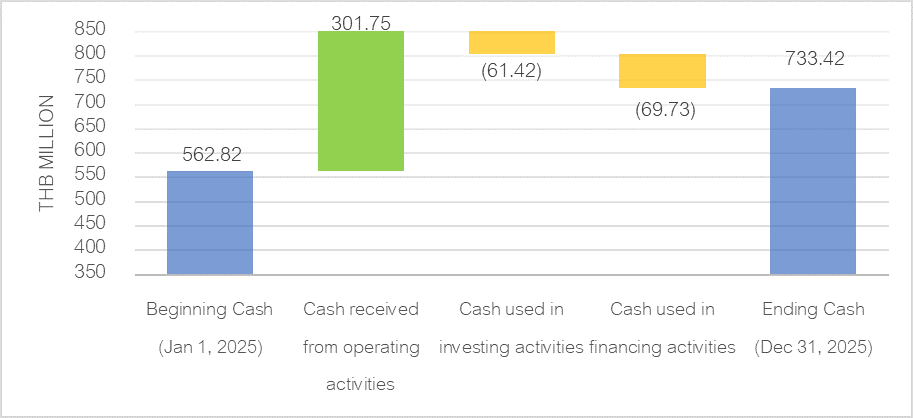
| 3. Cash flows | As of December 31, 2025, the Company recorded cash and cash equivalents totaling 733.42 million baht. Details of each activity were summarized as follows: 3.1) Net cash flows from operating activities totaled 301.75 million baht. Key issues affecting changes were the followings: (+) Operating profits of 361.53 million baht; (+) Decrease in trade and other current receivables of 18.07 million baht; (+) Decrease in inventories of 12.93 million baht; (+) Decrease in other current assets of 0.15 million baht; (-) Increase in trade and other non-current receivables of 5.55 million baht; (-) Decrease in trade and other current payables of 51.36 million baht; (-) Employee benefit payments of 4.64 million baht; (+) Interest received of 2.42 million baht; (-) Interest paid of 0.50 million baht; (-) Corporate Income Tax payment of 31.33 million baht 3.2) Net cash flows used in investing activities totaled 61.42 million baht. This comprised 61.67 million baht in payments for the acquisition of machinery, equipment, and intangible assets, offset by 0.26 million baht in cash proceeds from the disposal of machinery and equipment. 3.3) Net cash flows used in financing activities totaled 69.73 million baht, consisting of dividend payments to shareholders of 65.51 million baht and lease liability repayments of 4.21 million baht. Chart summarizing cash flows of the year :
|
Debt Securities with Financial Ratio Requirements
Debt Securities with Financial Ratio Requirements Issued?
No
Factors That May Affect Financial Condition
Factors or Incidents That May Materially Affect Financial Condition
Thai Economic Outlook
The Thai economy in 2026 is projected to expand by 1.5% – 1.6%, lower than in 2025. This decrease is attributed to several factors, including a contraction in private consumption resulting from a slow and fragile recovery in labor income, high household debt, contraction in credit in line with economic conditions, and more cautious lending practices by financial institutions. Additionally, political uncertainty may lead to delays in budget disbursement and the implementation of economic stimulus policies. Energy costs are likely to trend higher if the unrest in the Middle East becomes prolonged and escalates.
Thai Automotive Industry
The Thai automotive industry in 2026 is expected to experience a slight expansion compared to the previous year, driven by anticipated growth in electric vehicle (EV) sales. This growth is expected to be stimulated by the launch of new models, improved infrastructure readiness, and a de-escalation of price wars. Simultaneously, the rising popularity of EVs is leading to a continuous decline in the production volume of Internal Combustion Engine (ICE) vehicles. This situation may affect the Company’s performance in terms of battery sales to domestic vehicle manufacturers (OEM); however, a severe impact is not anticipated as this segment accounts for approximately 1 percent of total sales revenue. Nevertheless, the automotive industry continues to face other challenges from several factors, including diminished private purchasing power, market penetration by imported vehicles, an aging society, and softening demand from trading partners. Conversely, certain factors may positively influence battery sales in the replacement market (REM), such as the popularity of ride-hailing services and the increasing average lifespan of vehicles globally.
Battery Market Situation, Major Customers, and the Company’s Operational Plan
Mergers among battery manufacturers and intensified competition from Chinese producers are expected to keep market competition at a high level. In response, the Company has established strategies to maintain price competitiveness, improve production costs, and enhance product development. Operational plans are being reviewed periodically to ensure alignment with the evolving market situation.
There is a possibility that the Company's key customers in the automotive manufacturing sector may consider relocating the production base for certain models from Thailand to other countries in Southeast Asia to maintain their competitive advantage. This move would be driven by expectations of cost benefits, localized demand, or government incentives. Additionally, customers may consider sourcing batteries from other regional suppliers, which could impact the Company's OEM sales volume. However, the impact is expected to be limited, as these manufacturers still need to maintain their production capacity and market share within Thailand. Furthermore, the Company continues to implement strategies to strengthen relationships and secure market share with existing customers while consistently expanding its customer base beyond its traditional core groups.
Raw Material Prices
Lead, the primary raw material for the Company’s production, is generally expected to remain stable or fluctuate within a narrow range throughout 2026. Most forecasts project an average price of approximately $2,000 USD per metric ton. The market is anticipated to remain in a balanced state, supported by a modest expansion in supply. However, some sources suggest a potential slight price uptick to around $2,112 USD per metric ton. Regarding the long-term outlook, certain analyses indicate that the transition to electric vehicles (EVs), combined with high inventory levels at the London Metal Exchange (LME), will likely act as constraints preventing any significant price surges.
Exchange Rate
The Thai Baht is projected to depreciate in the second half of 2026. This outlook is driven by the expansion of the U.S. economy, the persistently weak performance of the Thai economy, and high levels of domestic political uncertainty. The weakening of the Baht is expected to enhance the price competitiveness of the export sector and may potentially bolster sales within the commercial vehicle segment. However, the exchange rate may experience high volatility as long as the unrest in the Middle East remains unresolved.